
Advanced tree pruning refers to targeted cutting strategies that shape structural form, reduce risk, and promote long-term tree health through biology-based techniques. These methods—structural pruning, crown reduction, crown thinning, selective pruning, and support systems like tree cabling and bracing—improve load distribution, light penetration, and wound closure to extend a tree’s lifespan and protect property. This article explains why and when to apply each technique, outlines core principles for safe cuts, and shows how maintenance pruning prevents disease while improving resilience to storms. You will learn specific procedures for young and mature trees, discover practical timing guidelines for common species, and get a clear comparison of trimming options so you can decide when to call a professional. The guidance integrates current research and arboricultural standards to help homeowners recognize poor pruning practices and choose interventions that preserve canopy function and structural integrity.
Volusia Bobcat & Tree Service is a local tree service provider in Central Florida that can assist homeowners with advanced pruning strategies and on-site assessments. Their crews include certified arborist expertise relevant to structural pruning and selective pruning, and they offer free onsite quotes to evaluate complex pruning needs. Mentioning a professional early helps homeowners plan safe interventions rather than attempting risky DIY cuts. If you prefer professional diagnosis or need help deciding between crown reduction or cabling and bracing, contact Volusia Bobcat & Tree Service for an initial assessment and a tailored pruning plan.
Structural pruning is a proactive pruning strategy that develops a strong branch architecture during early growth to reduce future risk and encourage healthy form. By selectively removing or reducing competing leaders, correcting codominant stems, and spacing scaffold branches, structural pruning improves load distribution and reduces the likelihood of branch failure. The intent is to guide natural tree biomechanics so wind and weight stresses are borne by well-anchored limbs rather than weak attachments, which enhances long-term tree health and reduces storm damage.
Below is a concise comparison of structural pruning goals, timing, typical cuts, and expected outcomes to clarify when and how to apply the method.
Structural pruning goals and attributes:
| Goal | Timing | Typical Cut | Expected Outcome |
|---|---|---|---|
| Develop single strong leader | Early formative years | Remove competing leaders, subordinate stems | Improved vertical stability and leader dominance |
| Improve scaffold spacing | Juvenile growth phase | Thin to 4–7 primary scaffold branches | Balanced canopy with reduced shading and decay |
| Reduce codominant risk | As defects appear | Remove one stem or reduce size, preserve branch collar | Lower failure risk and better wound compartmentalization |
This table highlights that structural pruning is preventive and most effective when applied early, delivering measurable reductions in future corrective needs and risk.
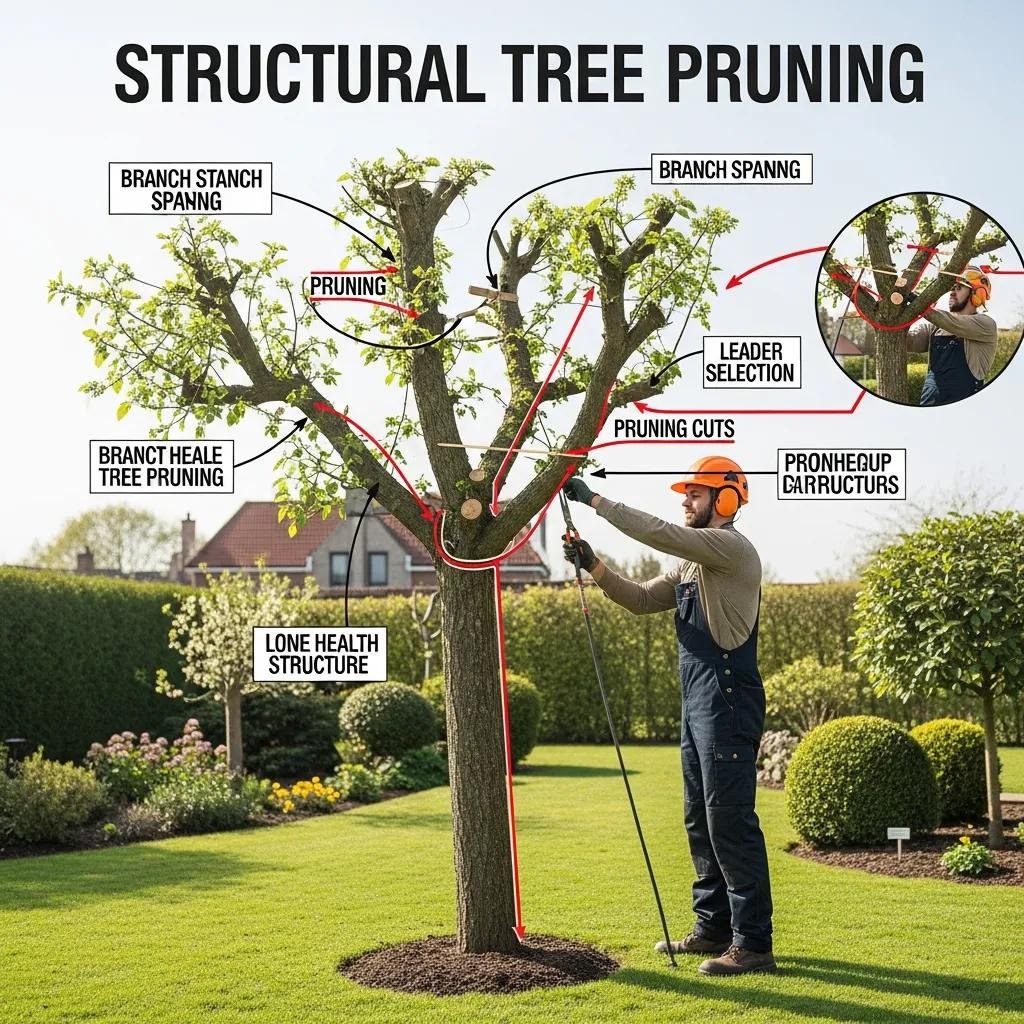
Structural pruning follows clear principles that prioritize tree biology and mechanical advantage over cosmetic shaping. The first principle is leader selection: establish a primary leader and remove or subordinate competing leaders to maintain a single, dominant stem. Second, maintain proper branch spacing and angles by selecting scaffold branches with wide crotch angles and removing narrow, weak attachments that encourage included bark. Third, use progressive reduction cuts to subordinate vigorous stems rather than large removals that cause oversized wounds; always preserve the branch collar to support effective woundwood formation.
Applying these principles early in a tree’s life reduces the need for major corrective work later and leads directly into how pruning reduces specific failure modes.
Structural pruning mitigates common failure modes—codominant stems, included bark, and excessive end weight—by altering branch hierarchy and reducing leverage on weak attachments. Corrective cuts shorten long limbs and redistribute loads toward stronger scaffold branches, while small, staged reductions avoid large wounds and promote effective compartmentalization. When weaknesses are already present, tree cabling and bracing can complement pruning by providing mechanical support during healing and storm events, reducing immediate risk while the tree strengthens biologically. Understanding these mechanisms helps homeowners appreciate why timely structural pruning is an investment in safety and tree longevity.
Maintenance pruning focuses on removing dead, diseased, or crossing branches to sustain canopy function, improve airflow, and minimize pest and disease habitats that compromise tree vigor. Regular sanitation cuts, careful thinning, and selective removal of weak wood preserve photosynthetic capacity and reduce fungal colonization, which supports overall tree health over decades.
A simple seasonal framework—inspect in late winter or early spring, perform sanitation and light thinning as needed, and avoid heavy cuts during peak growth—keeps maintenance efficient and biologically sound.
The following list summarizes practical maintenance pruning techniques homeowners should expect from a competent arborist or trained crew.
These techniques form a routine that emphasizes tree health. Regular maintenance pruning reduces the need for emergency removals and supports the tree’s natural defense mechanisms, leading to long-term cost savings.
Effective disease prevention through pruning combines sanitation, correct cutting technique, and early diagnosis. Always disinfect tools between cuts when dealing with infectious disease, remove infected material well away from healthy tissue, and avoid flush cuts that damage branch collars.
Thinning cuts maintain canopy function while cleaning cuts remove problematic wood; distinguishing between them prevents unnecessary damage.
Look for early warning signs such as localized dieback, leaf discoloration, or fungal fruiting bodies on trunks—early intervention with targeted pruning often stops pathogen progression and preserves canopy health.
Scheduling maintenance pruning depends on species biology, local climate, and property risk factors; however, a practical decision framework helps homeowners plan. For many broadleaf species, late dormant season work minimizes sap loss and reduces insect activity, while avoiding pruning during active fungal spore release reduces infection risk. Young trees benefit from formative pruning every 1–3 years, whereas mature trees typically need inspection and selective maintenance every 3–5 years unless hazards are identified sooner. Proactive scheduling prevents emergent hazards and spreads maintenance costs over time, offering better long-term outcomes than waiting for problems to become severe.
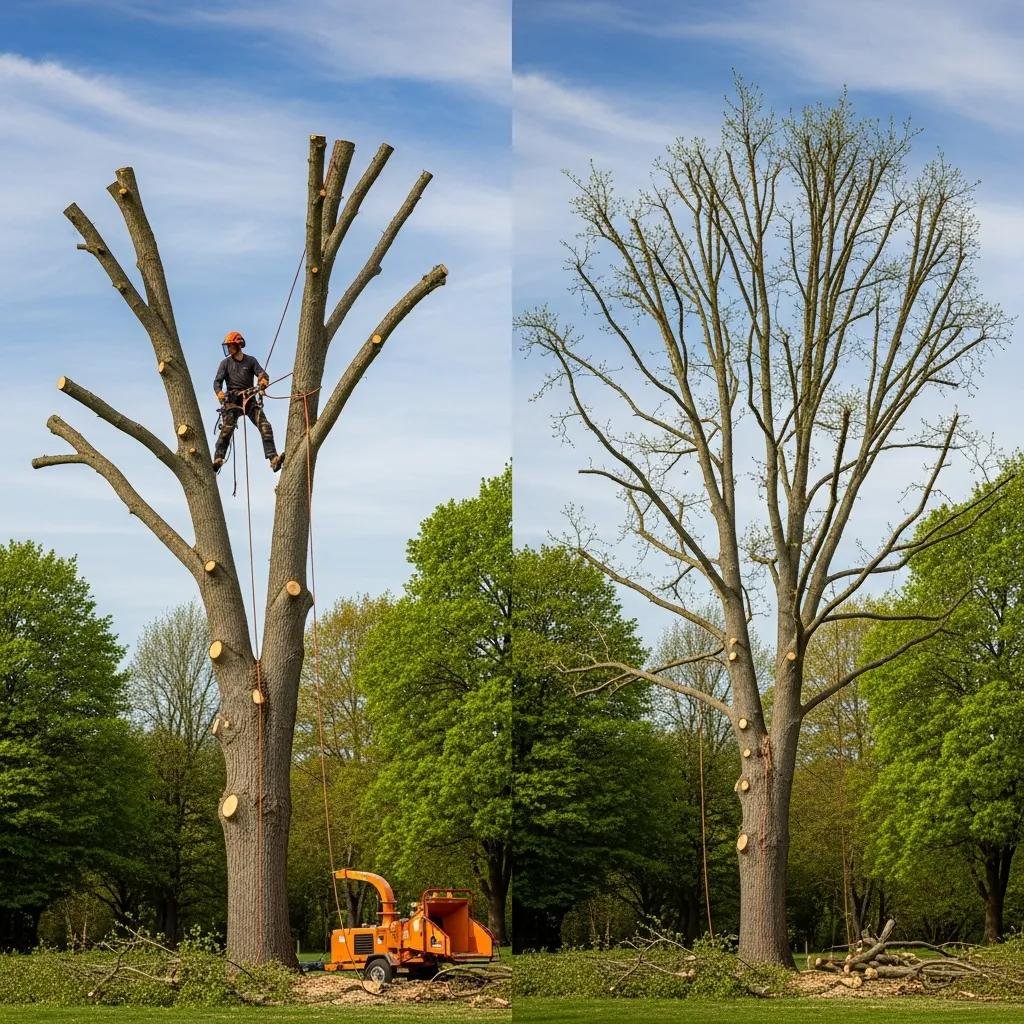
Advanced canopy management includes crown reduction, crown thinning, and selective trimming—each serving distinct objectives such as reducing height, increasing light penetration, or selectively removing problematic growth. Crown reduction safely shortens a tree while preserving form by reducing branch length back to laterals; crown thinning increases light and airflow by removing interior branches; selective trimming targets specific branches that interfere with structures or create hazards.
The table below compares crown reduction and thinning to help homeowners understand when each technique is appropriate and the relative benefits and risks.
| Technique | When to Use | Benefit |
|---|---|---|
| Crown reduction | To reduce height near structures or utilities | Lowers end weight and stress while maintaining canopy shape |
| Crown thinning | To increase light and airflow inside canopy | Reduces wind resistance and fungal risk |
| Selective trimming | To remove hazardous or rubbing branches | Targets specific problems with minimal canopy loss |
This comparison clarifies that technique selection balances safety, tree health, and property needs; selecting the wrong approach (for example, topping) can harm tree physiology.
“Trimming” often emphasizes clearance and aesthetics, while “pruning” focuses on biological outcomes such as structure, wound response, and disease management. Trimming by a landscaper may remove visible branches quickly, but improper cuts—especially topping—create large wounds, stress, and weak regrowth that increases long-term risk.
Pruning, following ANSI A300 standards and arboricultural principles, uses targeted cuts that consider branch collar preservation and the tree’s growth response. Recognizing this distinction helps homeowners choose appropriate services and avoid practices that superficially improve appearance but degrade tree health.
Crown thinning removes selected interior branches to create continuous spaces between remaining limbs, which allows sunlight to reach inner foliage and increases air movement through the canopy. These changes reduce humidity pockets where fungal pathogens thrive and improve inner-canopy photosynthesis, enhancing overall vigor.
Crown reduction, when staged over multiple seasons and executed with proper lateral targets, decreases leverage on weak attachments and prevents large wound formation. Applied correctly, both techniques improve microclimate around the tree and reduce pest and disease pressure while maintaining structural balance.
A certified arborist brings formal training in tree biology, risk assessment, and pruning standards that ensure interventions preserve tree health and comply with safety and regulatory expectations. Arborists evaluate decay, structural defects, and species-specific responses to cuts, then design pruning or support strategies such as tree cabling and bracing to address both biological and mechanical needs. Hiring a certified arborist reduces liability, improves long-term outcomes for the tree, and ensures that pruning follows best practices rather than ad hoc trimming.
Arborists evaluate decay, structural defects, and species-specific responses to cuts, then design pruning or support strategies such as tree cabling and bracing to address both biological and mechanical needs.
Professional service comparison:
| Service Option | Training & Tools | Typical Warranty/Outcome |
|---|---|---|
| DIY homeowner | Limited training, basic tools | Short-term fixes, higher risk of mistakes |
| General landscaper | Good for turf/hedge work, variable tree training | Aesthetic results, potential structural harm |
| Certified arborist | Tree biology, risk assessment, rigging expertise | Safer, longer-term tree health and risk reduction |
This comparison shows why certified arborist involvement yields better long-term results and lower risk compared with DIY or non-specialist work.
Certified arborists possess specialist knowledge in tree physiology, pruning standards, and structural assessment, enabling them to diagnose decay, determine appropriate pruning intensity, and design mechanical supports when needed. They apply species-specific pruning responses, select correct pruning cuts to encourage proper woundwood formation, and evaluate whether tree cabling and bracing are suitable adjuncts for weak attachments. Arborists also integrate current research and standards into practice, ensuring pruning supports both immediate safety and the tree’s long-term biological recovery.
Professional arborist crews use trained climbers, proper rigging, and equipment to protect the crew, the property, and the tree during complex pruning or removals. They follow safety protocols on-site, perform post-pruning inspections, and provide clear recommendations for follow-up maintenance or support installations. Homeowners should expect services that are licensed and insured and that come with service assurances; reputable firms often advertise free onsite quotes, 24/7 emergency services, and a 100 percent satisfaction / safety guarantee to demonstrate accountability. These assurances help homeowners choose qualified providers and align expectations for safety and quality.
For advanced pruning assessments or to schedule an evaluation, contact Volusia Bobcat & Tree Service to arrange a free onsite quote with a qualified arborist. Their team can advise on structural pruning, crown reduction, crown thinning, or tree cabling and bracing solutions tailored to Central Florida species and site conditions. This direct consultation helps translate the diagnostic guidance above into a practical, safely executed plan that protects both trees and property.